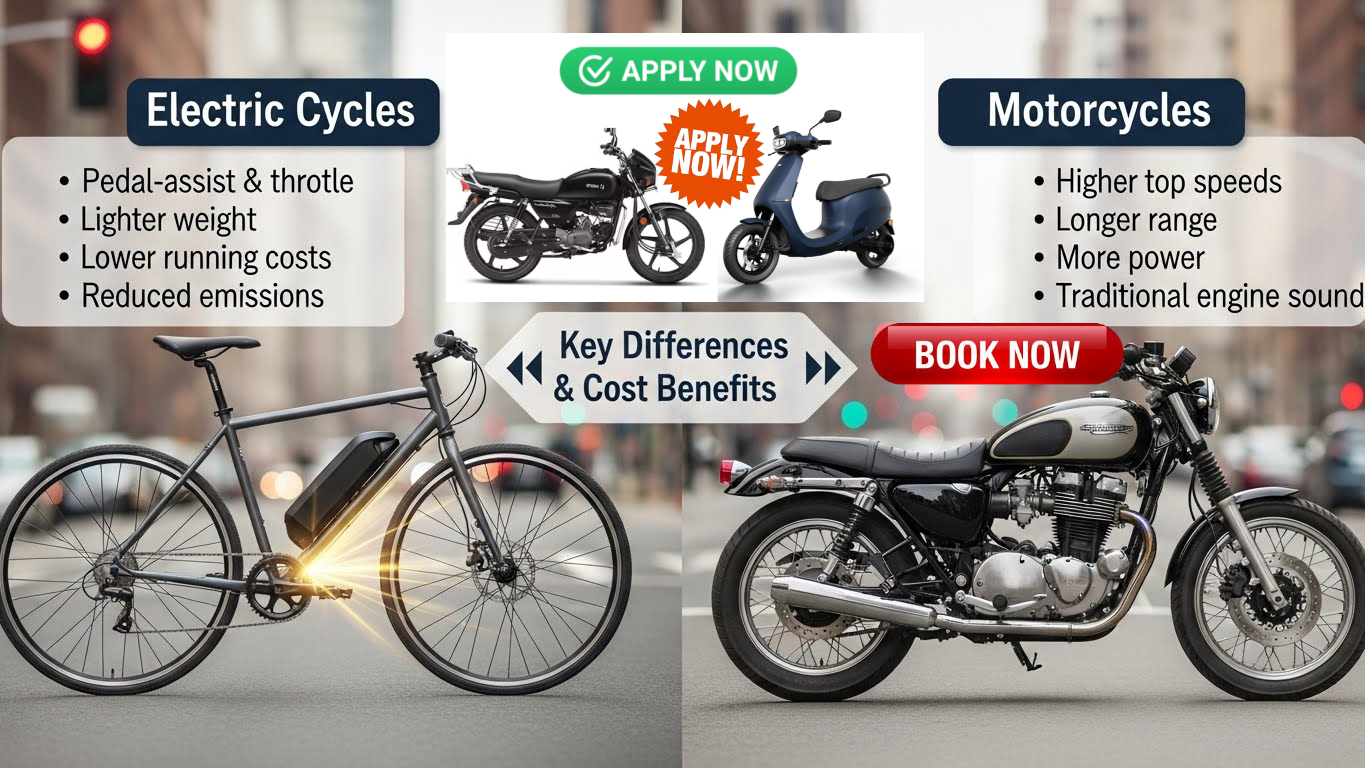
As urban mobility evolves and fuel prices continue to rise, people are increasingly comparing electric cycles (e-bikes) and motorcycles as alternatives for daily transportation. While both serve the purpose of personal mobility, they differ significantly in design, cost, usage, and long-term benefits. Understanding these differences can help riders choose the option that best suits their lifestyle and budget.
1. Power and Performance
Electric cycles are equipped with a small electric motor that assists pedaling or, in some models, operates independently at limited speeds. Most e-bikes are designed for city commuting, short distances, and moderate speeds.
Motorcycles, on the other hand, are built for higher performance. Whether powered by gasoline or electricity, motorcycles offer greater speed, stronger acceleration, and the ability to travel long distances comfortably, including highways.
Key difference:
-
Electric cycles focus on efficiency and assistance
-
Motorcycles prioritize speed and power
2. Cost of Purchase
One of the biggest advantages of electric cycles is their affordability. A quality electric cycle typically costs a fraction of the price of a motorcycle. Entry-level e-bikes are accessible to students, commuters, and casual riders.
Motorcycles require a larger upfront investment. Beyond the purchase price, buyers often pay additional costs for registration, insurance, and protective gear.
Cost comparison:
-
Electric cycle: Low to moderate initial cost
-
Motorcycle: High initial cost
3. Operating and Maintenance Expenses
Electric cycles are extremely economical to operate. Charging an e-bike costs very little electricity, and maintenance is similar to that of a regular bicycle—basic servicing, brake checks, and occasional battery care.
Motorcycles involve higher running costs. Fuel or high-capacity battery charging, oil changes, engine servicing, insurance, and spare parts contribute to ongoing expenses.
Winner for low running cost: Electric cycle
4. Licensing, Registration, and Legal Requirements
In most regions, electric cycles do not require a driving license, registration, or insurance, especially if they fall within regulated speed and power limits. This makes them accessible to a wider range of users.
Motorcycles almost always require a valid license, registration, insurance, and compliance with traffic regulations. These requirements add time, responsibility, and recurring expenses.
5. Environmental Impact
Electric cycles are among the most eco-friendly transport options available. They produce zero direct emissions, consume minimal energy, and help reduce traffic congestion and noise pollution.
Motorcycles, particularly fuel-powered ones, emit greenhouse gases and pollutants. Even electric motorcycles, while cleaner, consume more energy and resources than e-bikes.
Environmental advantage: Electric cycles
6. Practical Use and Convenience
Electric cycles are ideal for short commutes, crowded city streets, and areas with limited parking. They are lightweight, easy to maneuver, and can often be parked without special spaces.
Motorcycles are better suited for longer commutes, highway travel, and carrying passengers or cargo. However, parking, traffic navigation, and safety concerns can be more challenging in urban environments.
7. Safety and Riding Experience
Motorcycles require advanced riding skills due to higher speeds and heavier weight. Accidents at high speeds can be severe, making safety gear essential.
Electric cycles operate at lower speeds, reducing accident severity and making them more beginner-friendly. Riders still need caution, but the overall risk level is generally lower.
Conclusion: Which One Is Right for You?
The choice between an electric cycle and a motorcycle depends on your needs:
-
Choose an electric cycle if you want an affordable, eco-friendly, low-maintenance option for daily commuting and short trips.
-
Choose a motorcycle if you need higher speed, longer travel range, and greater power for highways or long-distance rides.
For many urban commuters, electric cycles offer unbeatable cost benefits, convenience, and sustainability, while motorcycles remain the better choice for performance-focused riders.